Received 5 March 2019, Revised 20 June 2019, Accepted 3 July 2019, Available online 4 July 2019, Version of Record 10 July 2019.
Abstract
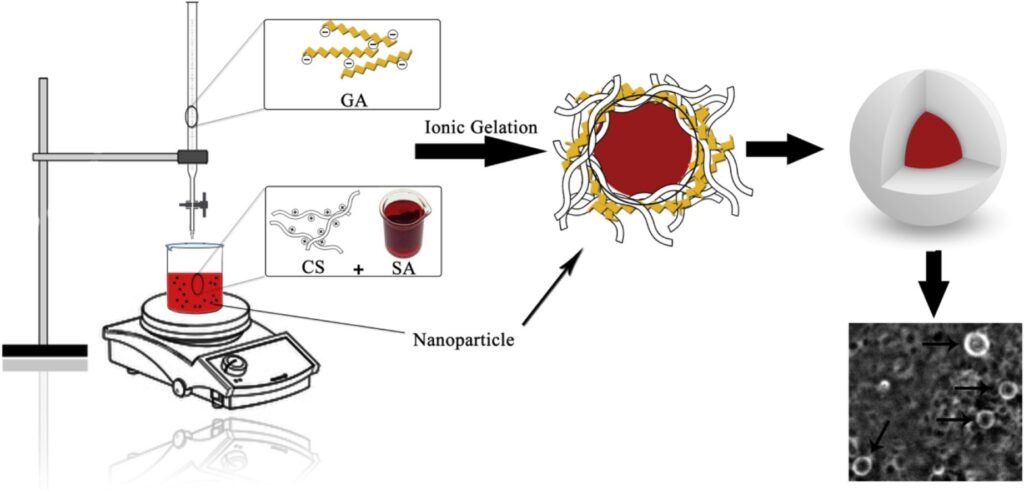
Evaluating the proficiency of complex based polymers in order to increase the bioavailability and protection of bioactive compounds through nanoencapsulation has been studied during last years. The present work reports on preparation of saffron extract included-nanocomplexes of chitosan (CS) and gum Arabic (GA) through ionic gelation (IG). Fourier transform infrared (FTIR) spectroscopy and X-ray diffraction (XRD) confirmed the formation of bonds between functional groups (−COO− and –NH3+) of the two biopolymers and the creation of an amorphous structure. Transmission electron microscopy (TEM) illustrated the spherical and smooth shapes and approximately uniform particle size distribution of final nanocapsules. The size, PDI and zeta potential of produced nanoparticles was in the range of 183–295 nm, 0.272-0.612 and 20.5–50.5 mV, respectively. The levels of CS, GA, and saffron extract significantly influenced the properties of nanocomplexes and their encapsulation efficiency. An increase in CS and GA within complexes gave rise to the encapsulation efficiency from 29.12 to 52.34%, by increasing the attractive forces between the positive and negative groups of these two biopolymers on one hand, and by raising zeta potential on the other hand. The release profiles of saffron bioactive components (picrocrocin) in acidic and neutral environments were significantly different due to changes in chitosan solubility, brought about
40% difference in the first 60 min of release. To conclude, nanoencapsulation of saffron extract through ionic gelation of CS and GA was an efficient protective method in order to produce a stable form of saffron.
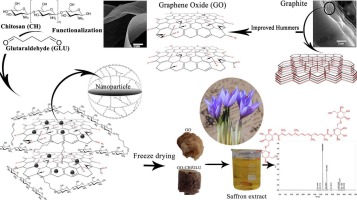
Graphical abstract
Introduction
In recent years, researchers are looking for different strategies in order to elevate the functionality and biocompatibility of pharmaceutical and food bioactive components using nanotechnology relying on biopolymers [[1], [2], [3]]. It has been proved that this technology can improve the bioavailability of food and pharmaceutical active compounds [4,5] and inhibit the degradation of nutraceuticals such as antioxidants, enzymes, phenolic compounds, and micronutrients in unfavorable environmental conditions [6]. Ionic/ionotropic gelation, sometimes called as polyelectrolyte gelation/complexation is an efficient and applicable method for nanoencapsulation as a result of applying nontoxic and highly biocompatible polymers [7]. This complexation is formed through the mixing of oppositely charged biopolymers in solutions at very low concentrations; lower than their gelling points, and their interaction mainly driven by hydrogen bonds, electrostatic associations and hydrophobic interactions [8,9], makes it essential to investigate the effect of structural composition and the ratio between the polymers [10]. Chitosan as a cationic polyelectrolyte is highly applicable in the pharmaceutics and food industry owing to its unique properties such as mucoadhesiveness, nontoxicity, biocompatibility, biodegradability, and extractibility from an economical and plentiful source [[11], [12], [13]]. Due to the ionization of the amine groups of this biomolecule in acidic pH values, chitosan becomes water-soluble and positively-charged. This feature provides a basis for the reaction of chitosan with other negatively-charged macromolecules such as gum Arabic, carboxymethyl cellulose, alginate and heparine and resulting in the formation of complexed nanoparticles. Various reports have been presented about the reaction of chitosan with different biopolymers/ions for the preparation of bioactive-loaded nanoparticles. Among them, we can refer to the reaction between chitosan and tripolyphosphate [[14], [15], [16]], polyacrylic acid [4], gum Arabic [4,17,18], chitosan self-assembly [19] and reverse micellar carriers [20]. Different bioactive components have been also encapsulated through this approach including insulin [17,21,22], curcumin [16,18], bovine serum albumin [[23], [24], [25]] and various types of drugs [26]. Gum Arabic, a highly branched arabinogalactan-type polysaccharide is also a biocompatible and biodegradable polymer which readily dissolves in water up to 50% and its extremely compact structure gets easily opened in neutral pH values due to the dissociation of its hydroxyl groups, resulting in a high level of negative charged groups [27]. This brings about an increase in the number of gum Arabic reaction sites and negative charges compared with other biomolecules, thus providing a suitable condition for reaction with chitosan during ionic gelation [17]. Saffron, Crocus sativus L., is a perennial plant belonging to the Iridaceae family and Liliales order. The bioactive compounds of this plant includes picrocrocin (bitter taste of saffron), safranal (its main volatile compound and aroma) and crocin, a glycosidic ester of crocetin (color of saffron) [28]. Unique medicinal properties have been reported for saffron such as anticancer, anti-depression and anti-convulsion effects, which are majorly attributed to crocin [29,30]. Similar to most of the other herbal bioactive compounds which suffer from instability, crocin is susceptible to environmental conditions, particularly light and heat and degrades rapidly [28]. Production of nanocarriers via ionic gelation between two oppositely charged biopolymers is an innovative and biocompatible techniques which has been mainly applied for the encapsulation of drugs, proteins and genes. The purpose of this study was to prepare saffron-loaded nanocomplexes through IG between chitosan and gum Arabic and evaluate the properties of final nanocarriers and release of saffron extract from these delivery systems. The prepared nanoparticles were examined in terms of particle size, zeta potential, morphology, crystalline structure, encapsulation efficiency, and release.Section snippets
Materials and methods
Before sunrise, saffron was harvested from a field near Kashmar, Iran and the saffron stigmas were dried according to the method previously described by Rajabi, et al. [28]. In brief, after separation of stigmas from the flower, they were dried using a microwave oven at a power of 1000 W. Then, they were ground and passed through a sieve with a pore size of 0.421 mm. The resulting saffron powder was poured into a dark bottle and stored inside a desiccator for further experiments. ChitosanSaffron-loaded nanocomplex properties
The TEM images of the formulation for F4 (G1C1S15) and F7 (G5C10S10) are illustrated in Fig. 1. Assessment of these images revealed that the chitosan-gum Arabic nanocomplexes manufactured by these two treatments were nearly spherical with smooth surfaces and diameters of about 183–295 nm. These results conformed to those reported by Alishahi, et al. [14] who declared that the nanocapsules of vitamin C produced by chitosan (CS) and sodium tripolyphosphate (TPP) were smooth-surfaced andConclusion
Saffron is a medicinal plant with numerous applications in food and pharmaceutical industries. The bioactive compounds of this valuable plant are easily degraded when exposed to light, heat and oxygen. One of the major applications of polymer-based nanocarriers is the protection of bioactive compounds against unfavorable environmental conditions. In the present research, nanoencapsulation of saffron extract was carried out using CS and GA through ionic gelation. Higher GA and CS concentrationsDeclarations of interest
None.References (52)
-
- S. Akhavan et al.Lipid nano scale cargos for the protection and delivery of food bioactive ingredients and nutraceuticalsTrends Food Sci. Technol.(2018)
-
- I. Katouzian et al.Nano-encapsulation as a promising approach for targeted delivery and controlled release of vitaminsTrends Food Sci. Technol.(2016)
-
- Q. Hu et al.Formation of redispersible polyelectrolyte complex nanoparticles from gallic acid-chitosan conjugate and gum arabicInt. J. Biol. Macromol.(2016)
-
- S. Jafari et al.Nanotechnology Approaches for Increasing Nutrient Bioavailability(2017)
-
- Y. Luo et al.Recent development of chitosan-based polyelectrolyte complexes with natural polysaccharides for drug deliveryInt. J. Biol. Macromol.(2014)
-
- S. Ghasemi et al.Nanoencapsulation of d-limonene within nanocarriers produced by pectin-whey protein complexesFood Hydrocoll.(2018)
-
- N.D. Gonçalves et al.Comparison of microparticles produced with combinations of gelatin, chitosan and gum ArabicCarbohydr. Polym.(2018)
-
- A.K. HPS et al.A review on chitosan-cellulose blends and nanocellulose reinforced chitosan biocomposites: properties and their applicationsCarbohydr. Polym.(2016)
-
- A. Alishahi et al.Chitosan nanoparticle to carry vitamin C through the gastrointestinal tract and induce the non-specific immunity system of rainbow trout (Oncorhynchus mykiss)Carbohydr. Polym.(2011)
-
- B.R. Shah et al.Preparation and optimization of Pickering emulsion stabilized by chitosan-tripolyphosphate nanoparticles for curcumin encapsulationFood Hydrocoll.(2016)
-
- C. Tan et al.Polysaccharide-based nanoparticles by chitosan and gum arabic polyelectrolyte complexation as carriers for curcuminFood Hydrocoll.(2016)
-
- K. Lee et al.Preparation of chitosan self-aggregates as a gene delivery systemJ. Control. Release(1998)
-
- S. Mitra et al.Tumour targeted delivery of encapsulated dextran–doxorubicin conjugate using chitosan nanoparticles as carrierJ. Control. Release(2001)
-
- Y. Pan et al.Bioadhesive polysaccharide in protein delivery system: chitosan nanoparticles improve the intestinal absorption of insulin in vivoInt. J. Pharm.(2002)
-
- Y. Xu et al.Effect of molecular structure of chitosan on protein delivery properties of chitosan nanoparticlesInt. J. Pharm.(2003)
-
- Q. Gan et al.Chitosan nanoparticle as protein delivery carrier—systematic examination of fabrication conditions for efficient loading and releaseColloids Surf. B Biointerfaces(2007)
-
- A. Hosseini et al.Application of image processing to assess emulsion stability and emulsification properties of Arabic gumCarbohydr. Polym.(2015)
-
- H. Rajabi et al.Retention of saffron bioactive components by spray drying encapsulation using maltodextrin, gum Arabic and gelatin as wall materialsFood Hydrocoll.(2015)
-
- T. Shahi et al.Main chemical compounds and pharmacological activities of stigmas and tepals of ‘red gold’; saffronTrends Food Sci. Technol.(2016)
-
- M.A. Mehrnia et al.Crocin loaded nano-emulsions: factors affecting emulsion properties in spontaneous emulsificationInt. J. Biol. Macromol.(2016)
-
- A. Pant et al.Novel controlled ionic gelation strategy for chitosan nanoparticles preparation using TPP-β-CD inclusion complexEur. J. Pharm. Sci.(2018)
-
- D.J. Sullivan et al.Synthesis of monodisperse chitosan nanoparticlesFood Hydrocoll.(2018)
-
- D.A. Urban et al.Taylor dispersion of inorganic nanoparticles and comparison to dynamic light scattering and transmission electron microscopyColloid Interface Sci. Commun.(2018)
-
- M. Raei et al.Application of whey protein-pectin nano-complex carriers for loading of lactoferrinInt. J. Biol. Macromol.(2017)
-
- R.M. Mainardes et al.PLGA nanoparticles containing praziquantel: effect of formulation variables on size distributionInt. J. Pharm.(2005)
Cited by (122)
-
- pH-sensitive (halochromic) smart packaging films based on natural food colorants for the monitoring of food quality and safety2020, Trends in Food Science and TechnologyCitation Excerpt :In closing, although natural pigments provide a comparatively safe and eco-friendly alternative to synthetic dyes, the low stability of these pigments and their sensitivity to external factors, restricts their application potential. To this end, the use of nanocarrier-loaded and encapsulated colors as novel ingredients has been studied extensively to enhance the stability of natural pigments throughout the process (Assadpour & Jafari, 2019; Esfanjani, Jafari, Assadpoor, & Mohammadi, 2015; Khazaei, Jafari, Ghorbani, & Kakhki, 2014; Rajabi, Jafari, Rajabzadeh, Sarfarazi, & Sedaghati, 2019). Table 1 briefly describes the properties and structure of different natural colorants applicable to smart packaging.Show abstract
-
- Encapsulation of food bioactives and nutraceuticals by various chitosan-based nanocarriers2020, Food HydrocolloidsShow abstract
-
- Nano/microencapsulation of anthocyanins; a systematic review and meta-analysis2020, Food Research InternationalShow abstract
-
- Chitosan nanoparticles loaded with clove essential oil: Characterization, antioxidant and antibacterial activities2020, Carbohydrate PolymersShow abstract
-
- A comprehensive review on the nanocomposites loaded with chitosan nanoparticles for food packaging2022, Critical Reviews in Food Science and Nutrition
-
- Bioavailability of nutraceuticals: Role of the food matrix, processing conditions, the gastrointestinal tract, and nanodelivery systems2020, Comprehensive Reviews in Food Science and Food Safety