
By Seid-Mahdi Jafari 1, Maria Z. Tsimidou 2,
Hamid Rajabi 1, Anastasia Kyriakoudi 2
- 1
- Department of Food Materials and Process Design Engineering, Gorgan University of Agricultural Sciences and Natural Resources, Gorgan, Iran
- 2
- Laboratory of Food Chemistry and Technology (LFCT), School of Chemistry, Aristotle University of Thessaloniki (AUTH), Thessaloniki, Greece
Available online 17 January 2020, Version of Record 17 January 2020.
Abstract
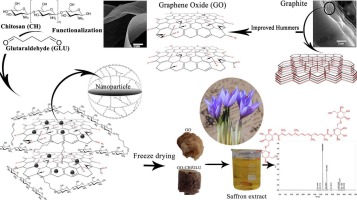
Although graphene oxide (GO) is a good adsorber, it has a low stability in pure form which can be improved by the development of GO-based composites. In this study, 3D nanostructures with GO, surface-decorated by nanocomplexes of chitosan (CS) and gum Arabic (GA), so called 3D GO-CS/GA nanocomposites were designed. The instrumental analysis confirmed the interaction of complexes with oxygenated functional groups of GO which improved both of d-spacing in 3D sheets by 16%, and GO thickness from 1.0 to 8.1 nm. Also, an unprecedented ~3-fold increase was observed in the surface area of 3D GO-CS/GA compared with single GO. The 3D nanocomposites showed a mesoporous structure with a pore volume of 0.72 cm3/g and a prevailing pore size distribution of about 10 nm. The adjustability of nanocomposite surface charge over pH was another important result. The synthesized nanostructures would be of profound interest for numerous areas including adsorption processes.
Abstract
Saffron, the most expensive spice in the world and so-called red gold, is composed of various bioactive compounds. The primary compounds are crocins, picrocrocin, and safranal, which contribute to its color, flavor, and aroma, respectively. Saffron is traded under various categories defined in national or international standards. Preharvest, and more importantly, postharvest processing and storage conditions have a significant influence on the bioactive content of saffron. Extraction methods proposed for the separation of these compounds are described briefly, along with common and more advanced analytical techniques for the determination of the different classes of the secondary metabolites. Trends and applications of saffron extracts or of individual metabolites in the food, pharmaceutical, and cosmetic industries are also discussed in this chapter with focus on the 21st century achievements.
References (0)
Cited by (21)
-
Surface-decorated graphene oxide sheets with nanoparticles of chitosan-Arabic gum for the separation of bioactive compounds: A case study for adsorption of crocin from saffron extract
2021, International Journal of Biological Macromolecules -
A review on bioactive compounds in sprouts: extraction techniques, food application and health functionality
2023, International Journal of Food Properties -
Novel Extraction Techniques: An Effective Way to Retrieve the Bioactive Compounds from Saffron (Crocus Sativus)
2023, Food Reviews International -
Bio-guided bioactive profiling and HPLC-DAD fingerprinting of Ukrainian saffron (Crocus sativus stigmas): moving from correlation toward causation
2021, BMC Complementary Medicine and Therapies -
Microbiome Fingerprint as Biomarker for Geographical Origin and Heredity in Crocus sativus: A Feasibility Study
2021, Frontiers in Sustainable Food Systems